
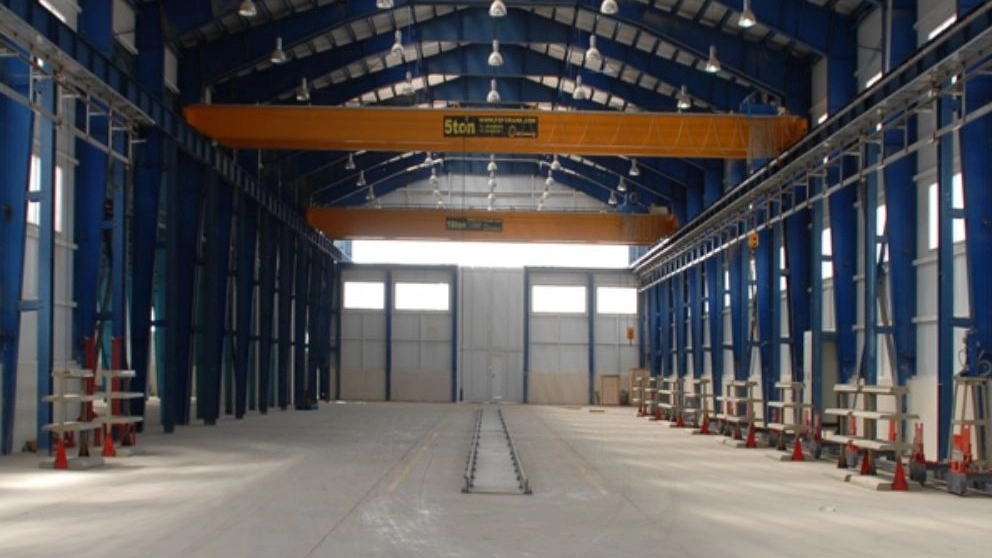
☑️ Ceiling crane
A roof crane is a structure that is used inside sheds, factories, workshops and other indoor environments for moving and carrying loads. In almost every industrial environment as well as various industries, when the weight of the equipment reaches more than one ton, the need for a overhead crane is immediately felt. And one of its main advantages is covering 90% of all areas of your area or hall without occupying the smallest useful working space. There are different types of overhead cranes, wall cranes, gantry cranes, semi-gantry cranes, and jib cranes, each of which has its own specific application. These cranes are four-way and six-way in three ways: longitudinal (north and south), transverse (left and right) and vertical (up and down).
☑️ Types of Ceiling cranes:
⚫️
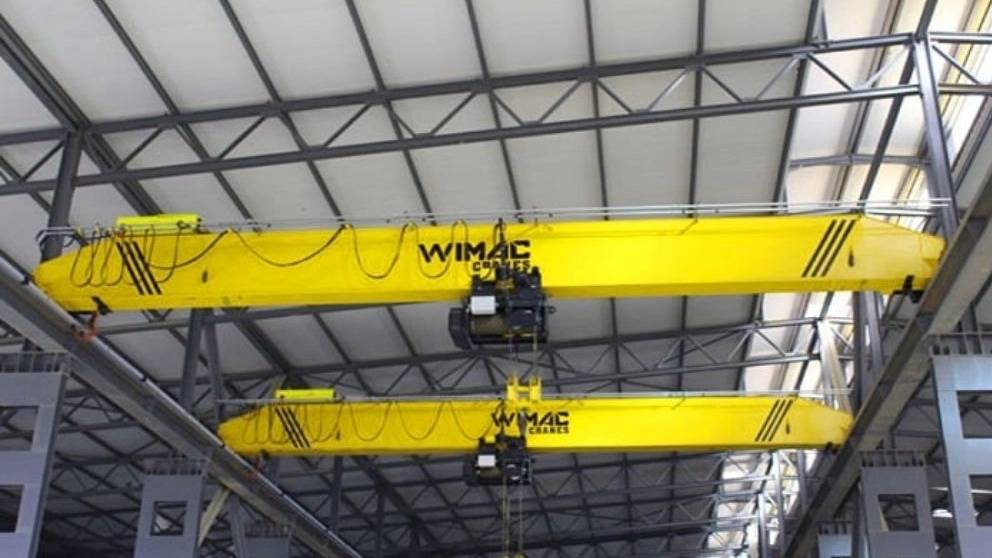
Single bridge overhead cranes are used to move materials in halls with small openings and tonnages of less than 10 tons, which reduces the dead load of the bridge on the columns of the structure and is economically more economical because the total weight It reduces the structure. In single bridge structures, one bridge is placed in line with the opening and two longitudinal guides that move the single bridge structure along the hall on the rails.
To move across the width of the opening by means of a trolley located in the elevator, which moves it with the elevator's transverse movement motor, and the movement along the hall is the responsibility of the longitudinal guides that move the elevator along the hall with the wheel box and gearbox engine. The disadvantages of this structure include lower working class and lower working height compared to double bridge overhead cranes.
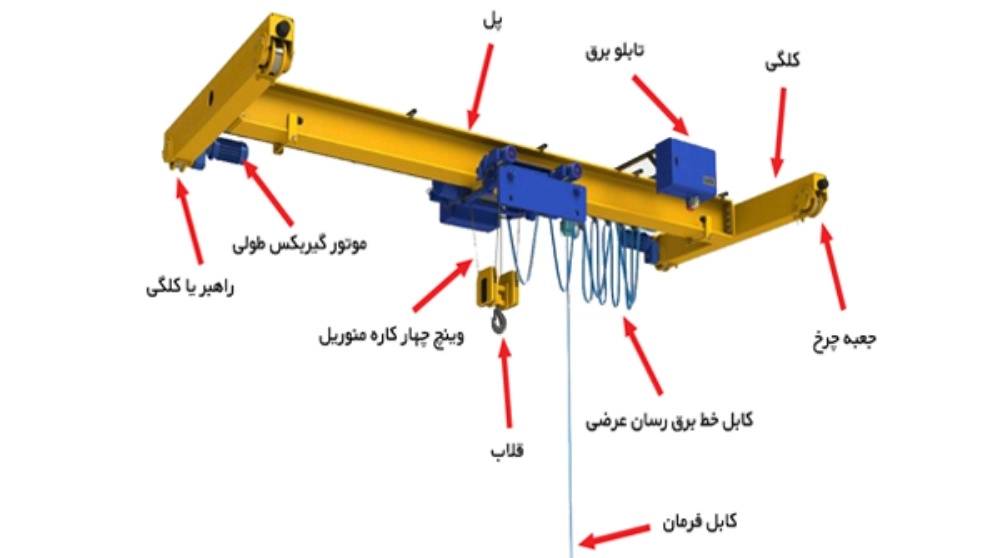
⚫️ Two bridges
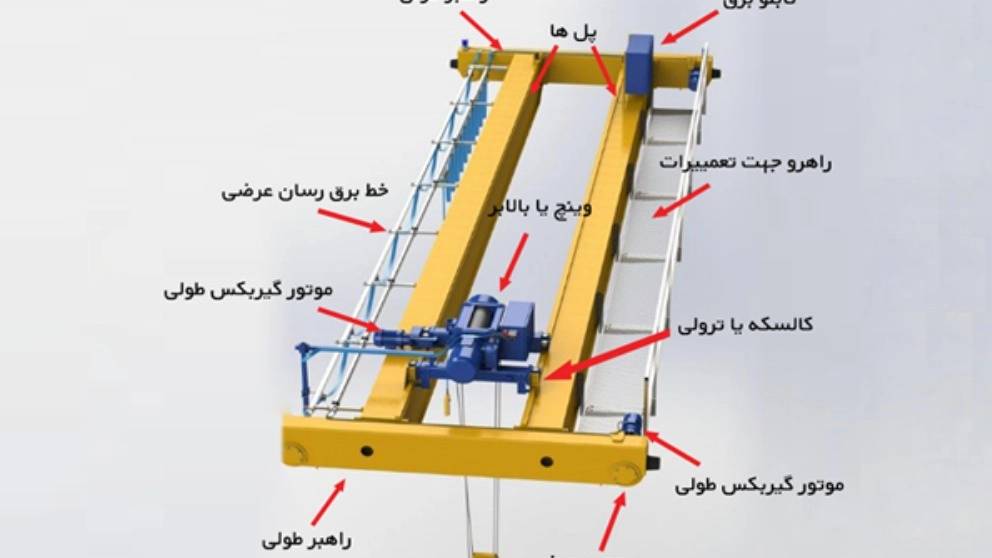
Double-bridge overhead cranes are the best solution for moving materials in halls with a span between 10 and 50 meters and a capacity between 1 and 100 tons have many uses and also with this structure you get the best working class and the highest working height, and also by using engineering calculations and building the structure according to the standard and with low dead weight, you can also get the best use from an economic point of view, as well as another advantage This type of cranes is that in addition to the ease of access and the possibility of repairing trolley parts, with the presence of a selected corridor in the crane body, it also provides a suitable opportunity to repair and replace hall lamps, hall heating facilities and power lines.
☑️ Direct and curved ceiling crane
This type of crane in cases where you are not able to install columns and beams By setting up this system, you have the possibility to easily move objects in the hall area, and also this system is very useful for moving materials with an opening between 4 and 10 meters and a capacity between 0.5 and 10 tons, which is very useful in this type of structure. It provides you with the possibility of maximum lateral access (more than the opening of the working beam) or the maximum working height, as well as the ability to move the lift in any direction. This type of crane is mostly used in the menu rail industry and it is available in two types of direct and overhead cranes.
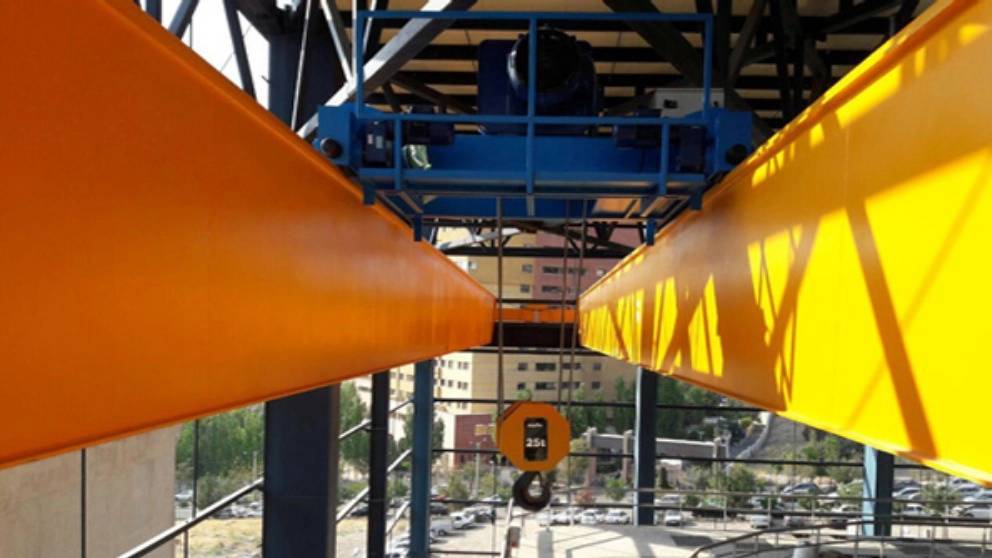
☑️ Characteristics of the ceiling crane
A little cost is needed to maintain the overhead crane.
The overhead crane can reach all points independently.
The cost to repair the overhead crane is low.
The overhead crane will save energy.
The best option for moving parts that have heavy weight will be the overhead crane.
No special skills are needed to use a ceiling crane and it is very easy to do.
☑️ Ceiling crane applications
Let's get to know the overhead crane a little easier and get to know it. As it is clear from the name of this type of crane, the overhead crane is a device that is installed in the upper part of the shed columns in workshops or factories. These types of cranes are made of single-bridge types, such as single-bridge overhead cranes, single-bridge overhead cranes, double-bridge overhead cranes, and double-bridge overhead cranes. Note that the components of single-bridge and double-bridge overhead cranes are not much different from each other except in limited cases. A single-bridge overhead crane uses one bridge to move and carry weight, and a double-bridge overhead crane, such as a two-bridge overhead crane and a double-bridge overhead crane, uses two bridges to move around and bear the weight of the load. Therefore, it is clear that all types of double bridge overhead cranes are able to move very high weights. Therefore, it can be said that these types of cranes are mainly used in large factories. Therefore, based on these two factors, it can be concluded that the price of the overhead crane with two electric bridges can be the most expensive type of overhead crane. Of course, which brand or which country produced it and what after-sales service it provides is also very important in pricing.
Therefore, if we want to summarize, a ceiling crane is considered a type of crane that, by connecting to the ceiling, provides the possibility of horizontal and vertical movement of heavy objects from several hundred kilos to several hundred tons. Don't you think this is a miracle? A device that can lift a few hundred tons of cargo from the ground for us and transfer it to another point? This is what many small and large industries call a miracle.
☑️ Crane Crane Components
The most important part of overhead crane and any other crane is its winch. A winch is a device that produces the necessary power to move objects. In fact, the fact that you can see that a crane in different models can move objects of several hundred tons, all goes back to the technology of making its winch. The winch is made of three basic components: motor, gearbox and drum. Let us explain a little more. The winch converts the force we give it into mechanical force, and the gearbox adjusts this force according to the user's needs and transfers it to the drum. The drum also causes the load to move by converting the received force into a driving force. Now, the input power can be electric, gasoline, hydraulic, etc. In fact, it mostly depends on the manufacturer and of course your needs. But that's not all. The force entered into the winch must be restrained in some way. In all types of trolley or trolley overhead cranes, they are responsible for receiving and neutralizing this force with the help of bridges. These bridges and the aforementioned trolley must be able to withstand and neutralize the maximum defined force without bending or breaking. Four up and down movements of the crane are done with the help of winch and trolley. However, the north and south movement of the crane is done by the guide or clegi, which is a mechanical structure that is made in the form of a box from ST37 sheet or standard sections such as studs or beams and is coupled to the flange of the bridge by a flange on the side. The guide (or head) may be equipped with a driving and moving wheel box at the beginning and end, or the wheels can be placed inside the head box itself. The length of the head box depends on the opening of the crane and it is designed and manufactured according to DIN15018 standard.
Now imagine that the quality of the construction of the crane is not suitable enough to withstand this force. Imagining the disaster that can happen shows how hard and complicated the technology of making these types of cranes is. Therefore, only a few European, American and of course Asian countries manage to design and manufacture these types of devices. Other countries and various brands are either present in this market as assemblers or are stealing and copying this technology.